
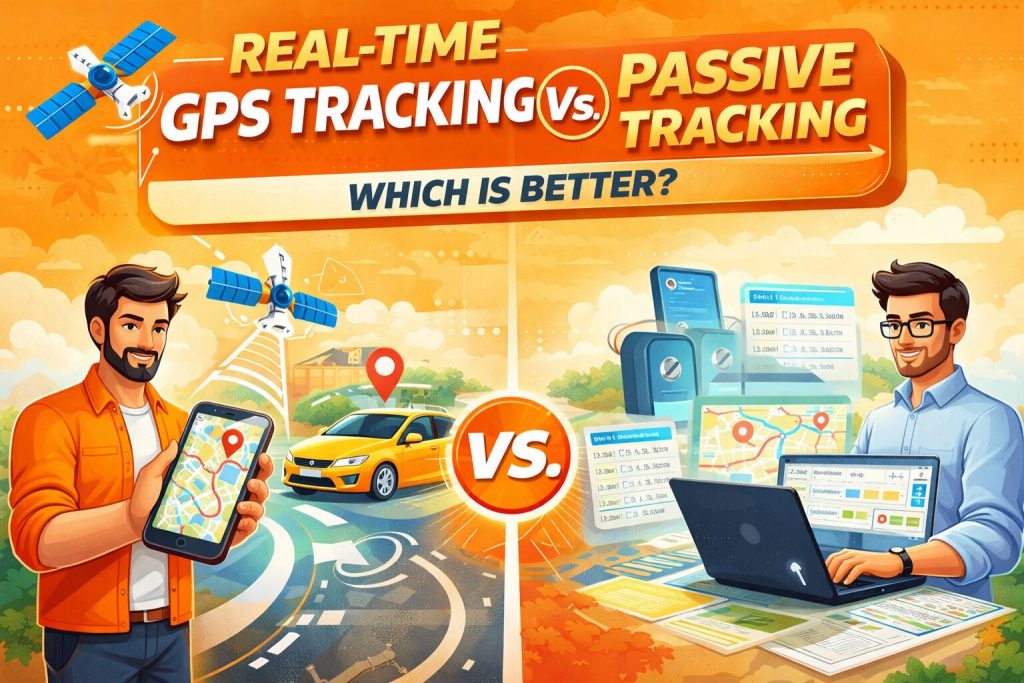
GPS tracking is commonly applied in vehicle security, fleet management, and monitoring of assets. Nonetheless, not every GPS tracking system operates in a similar manner. It can be real-time GPS tracking and passive GPS tracking. Although the two technologies capture the location data, they vary in terms of information storage, transmission, and access by the user. Knowledge about the differences between real-time and passive tracking can help people and companies decide on the most appropriate solution to their requirements. iTracker is here to let you know about ‘Real-time GPS Tracking Vs. Passive Tracking: Which is Better?’
What is Real-Time GPS Tracking?
Real-time GPS tracking refers to a system whereby a GPS device transmits location information constantly to a central server. The position of the vehicle can be tracked in real-time by using a mobile application or a web dashboard. Such tracking is based on mobile networks like 2G, 3G, or 4G to send real-time information. The features are:
- Instant location updates
- Constant communication of data
- Access by means of mobile applications or the web
- Timely alerts and notifications
It is typical for fleet management to use real-time tracking in applications such as delivery services, ride-sharing platforms, and vehicle security systems. Information is regularly updated, and hence, one will always have the location of the vehicle at any given time.
What is Passive GPS Tracking?
Passive GPS tracking is not similar to real-time tracking. The device does not transmit the data constantly, but the location information is stored in the internal memory.
The user is able to obtain the information subsequently by downloading it to the device. Passive tracking has the following characteristics:
- Location data is stored within the phone.
- No permanent network access is needed to the internet or mobile network.
- Data is accessed after the trip is done.
Passive trackers capture information including:
- Travel routes
- Speed information
- Time and distance covered
Such kind of tracking is mainly applied in research, travel analysis, and route monitoring as opposed to real-time vehicle monitoring.
Differences between Real-Time and Passive Tracking
Being aware of the key distinctions between the two systems allows users to make the appropriate choice of technology.
- Data Transmission
Real-time tracking transmits data immediately using the mobile networks. Passive tracking records the information in the memory and uploads it at a later date.
- Monitoring Capability
Live tracking enables users to know the vehicles in real time. Passive tracking only gives the information at the end of the trip.
- Connectivity Requirement
SIM cards and mobile connection networks are needed in real-time systems. Passive systems do not require internet connectivity.
- Alerts and Notifications
Some real-time trackers may provide real-time alerts concerning violations of speed or movement, or a geo-fence. Passive trackers are not in a position to give real-time alerts. Such variations have a very important impact on the use of each system.
Advantages of Real-Time GPS Tracking
Tracking systems in real-time have several significant benefits, particularly to a business and the owners of vehicles. Some key benefits include:
Immediate Location Updates
The mobile application helps users to know the exact position of a vehicle in real-time.
Improved Vehicle Security
In the case of a stolen vehicle, the real-time tracking will enable the owner to find the vehicle fast and report the matter to the authorities.
Management Effectiveness of Fleets
Companies have the opportunity to track several vehicles at a time and improve the routes.
Instant Alerts
Real-time systems can inform the user about illegal traffic movement of vehicles, speed limit violations, and geo-fence entry or exit Such warnings assist in enhancing safety and control over operations.
Advantages of Passive GPS Tracking
There are also some benefits to passive GPS trackers in particular scenarios. Some benefits include:
Lower Operating Cost
Passive trackers do not necessarily need SIM cards or mobile data programs.
Simple Technology
The system is less complicated to work on since it does not require constant network connectivity.
Accuracy of Data on Trips Analysis
Passive tracking will give the exact route information that can be processed after the trip is made.
Battery Efficiency
The device does not transmit data at all times so battery consumption is normally less. Passive tracking may be a cost-efficient solution to some applications.
Limitations of Real-Time GPS Tracking
Despite the numerous advantages of using real-time tracking, it also has certain drawbacks. Such typical limitations are:
- Needs mobile network connectivity.
- Increased operating cost because of SIM and data usage.
- May drive up power usage.
Nevertheless, such shortcomings are often offset by the benefits of real-time surveillance and better security.
Limitations of Passive GPS Tracking
There are also a number of disadvantages of passive tracking. These include:
- No real-time monitoring
- No immediate alerts and notifications
- It is not possible to access the information until the device is retrieved
Due to these limitations, passive tracking cannot be used in cases when the instant information of the location should be available. As an example, passive tracking will not be useful in recovering a stolen car fast since the information is not sent in real time.
Which Tracking System is Better?
The user has to select the real-time and passive track according to his or her requirements.
Real-time GPS tracking is more suitable for:
- Vehicle theft prevention
- Fleet management
- Logistics and delivery operations
- Monitoring driver behavior
Passive GPS tracking is more suitable for:
- Travel route analysis
- Research or survey projects
- The cases that do not require live tracking.
Real-time tracking is usually the choice for most of the modern vehicle security and business applications. It is much more practical to use in everyday life due to the possibility of getting an instant update on location and alerts.
Conclusion
Both real-time GPS tracking and passive tracking systems play important roles depending on how you plan to use vehicle tracking technology. Passive tracking is ideal for storing travel data and reviewing routes after a trip is completed. It is useful for analyzing driving history, mileage, and route performance when live monitoring is not required.
However, real-time GPS tracking offers far more advantages for modern vehicle owners and businesses. With live location updates, instant security alerts, and continuous monitoring, real-time tracking significantly improves vehicle safety and fleet management efficiency. It allows businesses to track vehicles at any moment, respond quickly to emergencies, and maintain better operational control. For companies that rely on transportation, delivery services, or fleet operations, real-time tracking provides a smarter and more secure solution. That is why many individuals and organizations today prefer the Best GPS Tracker in Bangladesh that supports real-time monitoring, advanced security features, and reliable tracking performance.
Ultimately, choosing between passive and real-time tracking depends on your needs. But for better security, convenience, and full control over your vehicles, investing in the Best GPS Tracker in Bangladesh with real-time tracking capabilities is often the most effective choice. Hopefully, this guide on “Real-time GPS Tracking Vs. Passive Tracking: Which is Better?” has helped you understand the key differences and make a more informed decision.