
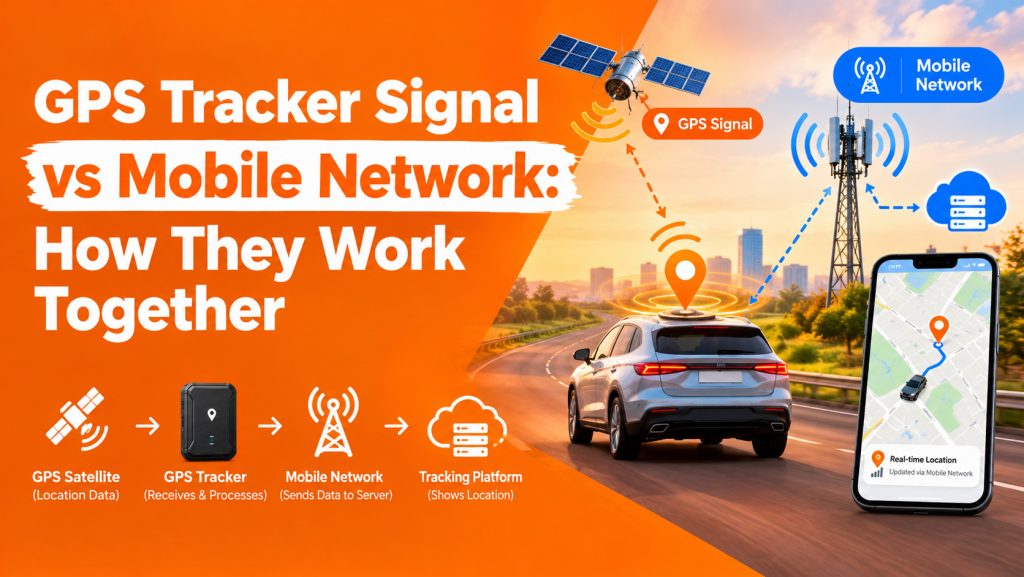
A vehicle GPS tracker may be one device but it is the combination of different technologies that enable you to track a vehicle remotely. Two of the most important are the mobile network and the GPS signal. Sometimes people use these words as though they mean the same thing, but they do very different jobs. GPS is used to determine the location of the vehicle , and then the mobile network is used to send this. If you are thinking about car GPS trackers, fleet tracking systems or vehicle monitoring solutions it can be helpful to know how these technologies work together before you choose a device.
What is a GPS Signal?
GPS ( Global Positioning System ) is a satellite-based positioning technology . Signals are sent out by the GPS satellites and can be received by suitable equipment on the ground. The GPS tracker then uses these signals to work out where it is. It receives signals from a number of satellites and can determine its position in latitude and longitude. Usually, information from GPS satellites does not reach your vehicle tracker. The tracker works by receiving satellite signals to find its bearings. For Instance, the tracker can find the location of a moving car in Dhaka using the GPS signals it has. Just because you can figure out that location doesn’t mean the owner can see it remotely.
How GPS and Mobile Network Work Together?
Now imagine that a vehicle GPS tracker has two jobs. First it has to find the vehicle position. What it does is receive signals from the GPS satellites. Secondly it has to communicate that position. This is passed via a cellular or other communication network depending on the device. The process brief is as follows:
GPS satellites → GPS tracker → mobile network → tracking server → Web platform/mobile app
The tracker receives the signals from the satellites and calculates its position. The device then sends location information over its communication link. It sends this information to the tracking platform and the user can access it on the platform. This can be done as long as the device is powered on and a tracking system can provide location updates over time.
Do GPS Trackers Need Mobile Network Service?
Most cell-based GPS trackers need a compatible cellular network to enable remote real-time tracking. The GPS receiver can usually still determine the vehicle’s location even if cellular service is temporarily lost. But if the tracker is unable to communicate with the network, it may not be able to send the latest location to the remote tracking platform.
What if the GPS signal is weak?
The environment around the vehicle can influence the GPS signal. Outdoors in open space one usually finds good conditions for satellite positioning. Tall buildings, underground parking facilities, tunnels, dense construction and other obstructions can prevent a tracker from obtaining good satellite signals. If the GPS signal is weak, it may take longer for the device to find its location, or it may provide less accurate location information for a period of time. The vehicle may still be located on the tracking platform but the location displayed can be known from the last successful location calculation or other data available. And that’s why the tracker being late on occasion does not mean it’s broken.
What If You Have Poor Mobile Network coverage?
The mobile network problems also affect another aspect of the tracking process. The GPS tracker can know its position accurately but may have a problem in sending this information to the tracking server. For example, a car operating in a region with limited cell coverage may not transmit live updates for some period of time. When the device reconnects to the platform it may display a previous location.
Why Does My GPS Tracker Sometimes Show Offline?
Many car owners ask themselves the question. Many possible reasons. The vehicle may be in an area with no or poor cell coverage. The tracker may also not be able to obtain a reliable GPS position , depending on its surroundings. Other possibilities include a disconnected power supply, low voltage on the vehicle battery, SIM related problems, connectivity service expired, device configuration issues or a temporary communication problem. So “offline” should not be interpreted as “GPS does not work”. The tracker may be working fine but not able to connect to the tracking platform at that moment.
What is the difference between a GPS signal and a cell network?
The analogy that is most obvious is this;
GPS signal = locate yourself.
Mobile network = sends location data.
The GPS system uses signals from positioning satellites . The tracking device uses a cellular network to communicate with its remote platform. In a normal cellular GPS tracking system, neither technology completely replaces the other. Without GPS positioning the tracker may not even know the exact location of the car. If you don’t have mobile connectivity, your tracker might know where it is but be unable to tell the owner in real time. Reliable communication and accurate positioning are therefore prerequisites for a trustworthy vehicle tracking system.
Does the GPS Tracker work even without a cell network ?
Depends what you mean by “work”.
A GPS tracker can know and record its location without being able to connect to the cellular network as long as the GPS receiver is working. But a typical cellular based tracker cannot give you continuous remote live tracking when it loses connection with its server. Some trackers avoid this by keeping location data locally. Once mobile coverage is regained, the device can upload the data to the tracking platform. Exact behavior is model dependent. There are other tracking technologies out there that use something like satellite communications. But these are in general special solutions and not the standard for vehicle-
tracking.
Why Mobile Connectivity Matters for Fleet Tracking
For companies, GPS is especially relevant for mobile networks. A fleet manager may want to track dozens or hundreds of vehicles, all from one platform. Each vehicle should be equipped with a tracker to determine its location and transmit the data reliably. With a strong communications link, companies can enjoy the benefits of real-time vehicle location, trip history, geofencing alerts, route monitoring and fleet visibility. This effect is dependent on the offline data handling of the tracking system in case the vehicle is
temporarily out of network coverage. If you are a company researching a vehicle tracking solution, you should ask questions about network compatibility, coverage, offline data storage, update frequency and platform reliability. IFAD Autos are the GPS tracking solutions and technology you need for effective vehicle monitoring.
How to Improve Your GPS Tracking Performance
You can’t control everything that affects GPS or cell signals, but you can make good choices when you install a tracker. You might want to think about how often you really need location updates. Regular updates may give more information concerning movement but may also affect data usage and power consumption of the device. The configuration will be different depending on the purpose of the tracker – personal car tracking, security, logistics, delivery operations, fleet management.
Common questions about GPS Tracker and Mobile Network Signals
Does a GPS tracker need phone data or GPS?
Both are normally used. The GPS signals tell the device where it is and the mobile data allows the tracker to transmit this location information to a remote tracking platform.
Can GPS work without mobile network coverage?
Yeah. Some GPS receivers can generally determine their location even without cell service. But if you have a cellular GPS tracker, that location information may not be transmitted to a remote server until cellular connectivity is restored.
Why is my GPS tracker reporting an old location?
If the tracker cannot get a new GPS position or send the latest information via the mobile network it could be an old location. Environmental conditions ,Power, coverage ,device settings may also be factors.
Does weak cell service can make your GPS less accurate?
Not quite. The only downside with a poor cell signal is that the tracker may not be able to send the data to the tracking platform. GPS reception is independent of cellular communication, but for real-time tracking, you’ll need both.
Do GPS trackers store data without network coverage?
Some vehicle GPS trackers store the location data locally when there is no network communication and upload it later when the network communication is resumed. It is contingent upon the device.
What happens when GPS trackers lose the GPS signal when they enter a tunnel?
That’s because GPS works by triangulating signals from a constellation of satellites orbiting the Earth, and tunnels are usually enclosed spaces that block the direct line of sight to the satellites. Therefore, when the GPS tracker is inside the tunnel it will not be able to find its location accurately using satellite signals. Some systems may store the last known position and update their data once GPS reception is restored.
Does a GPS tracker require a SIM card?
Many cell based GPS trackers communicate with their tracking platform via a SIM card or via built-in cellular connectivity. The exact setup will vary depending on your device and service provider.
Final Thoughts
GPS trackers don’t work off of one signal. GPS isn’t the same thing as cell networks, but they perform complementary jobs. GPS satellites inform the tracker of the vehicle’s location. The mobile network is used to transmit the location data from the tracker to a remote server or app. But when you are shopping for a car GPS tracker or vehicle tracking system, don’t just look at the basic GPS functionality. Consider network compatibility, coverage, offline data storage, reporting frequency, quality of installation and reliability of the tracking platform. These factors will be the ultimate test of the system’s utility for everyday driving and fleet operations.