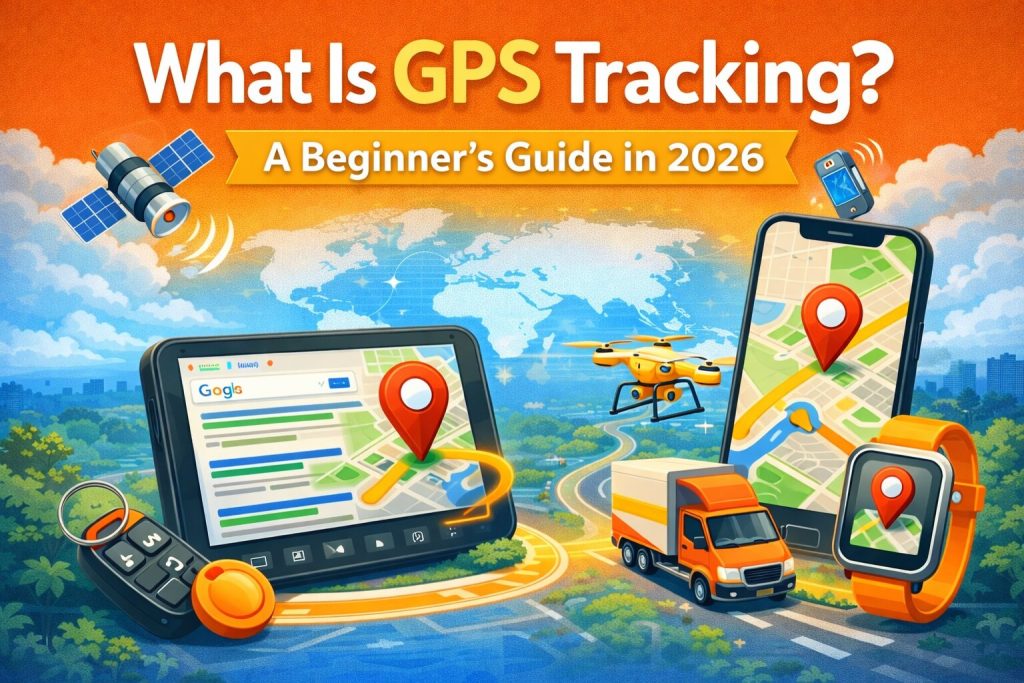
GPS tracking has become a widely used technology for monitoring the location of vehicles, people, and valuable assets. It is more developed, cheaper, and accessible in 2026 than ever before. GPS tracking systems are used in mobile apps and online platforms to give real-time visibility and control of personal safety, business fleet management, and more. With the increased number of people and businesses depending on location-based services, it is necessary to know how GPS tracking works. iTracker is here with a guide, ‘What is GPS Tracking? A Beginner’s Guide in 2026’ Keep reading!
What is GPS Tracking?
GPS tracking is a technology that involves the use of the Global Positioning System (GPS) in order to ascertain the exact location of an object. A GPS tracking device interacts with satellites that are swirling around the globe, computes its position, and forwards the information to the users. Applications of GPS tracking include:
- Tracking cars (bikes, trucks)
- Personal safety tracking
- Asset monitoring
- Business fleet management
The system enables users to see the positioning of a device on the fly using a smartphone application or a web dashboard.
How GPS Tracking Works
GPS tracking is achieved via a constellation of satellites, tracking devices, and communication networks. The process includes:
- Satellite Communication
Signals are constantly sent to the Earth by GPS satellites. Signals are sent to a tracking device by numerous satellites.
- Location Calculation
The device computes the position by a process known as trilateration, which is based on the signals of at least three satellites.
- Data Transmission
The tracker transmits the location information to a central server through mobile networks like 2G, 3G, 4G, or even 5G with advanced systems.
- User Access
The real-time location may be viewed by users in a mobile application or web interface. All this takes place within a few seconds, and therefore, tracking can be done instantly.
Types of GPS Tracking Systems
GPS tracking systems are categorized into various types that are meant to serve a certain purpose.
Real-Time GPS Tracking
- Transmits position information immediately
- Allows live monitoring
- Perfect for securing vehicles and fleet management
Passive GPS Tracking
- Stores data internally
- Will need manual downloading in the future
- Applied to analyze trips
Personal GPS Trackers
- Portable devices
- Used for personal tracking
- Frequently used as a safety measure or emergency
Both types fulfil various requirements since the user would wish to get location data in various ways.
Key Features of GPS Tracking in 2026
Modern GPS trackers have more than a simple location tracker. Important features are:
- Real-Time Location Tracking
Users have access to real-time tracking of the location of their vehicle or asset.
2. Geo-Fencing
Virtual boundaries may be configured, and an alert raised when the tracker crosses them.
3. Route History
Users are able to check previous trips and travel patterns.
4. Speed Monitoring
The system measures the speed of vehicles and issues warnings whenever speed limits are violated.
5. Mobile App Integration
The apps are linked to tracking systems to easily access and control.
6. Anti-Theft Alerts
When an illegal movement is detected, users will be notified. These characteristics render GPS tracking more effective and convenient.
Benefits of GPS Tracking
GPS tracking has many advantages for both individuals and businesses.
- Improved Security
GPS trackers are used to find stolen vehicles or things within a short period of time.
- Better Fleet Management
Companies are able to track various vehicles and enhance efficiency in their operations.
- Cost Savings
Tracking systems will assist in minimizing fuel consumption and needless travelling.
- Increased Safety
Speed and driving behavior monitoring is a way of encouraging safe driving habits.
- Convenience
With their smartphones, users can view tracking data at any time. These advantages have seen GPS tracking become a vital tool in most industries.
Applications of GPS Tracking in Bangladesh
GPS tracking is a common practice in various industries in Bangladesh. Common applications include:
- Personal Vehicle Security
Trackers are used by car and bike owners to avoid theft.
- Delivery Services and Logistics
Organizations monitor the delivery trucks to keep them on time.
- Ride-Sharing and Transport
Routes and driver performance are monitored by transport companies.
- Tracking Construction and Equipment
To avoid misuse or theft, heavy machinery is monitored. GPS tracking is important, especially in enhancing transport efficiency in urban areas as they expand and the amount of traffic is high.
Things to Consider Before Purchasing a GPS Tracker
Choosing the Best GPS Tracker in Bangladesh depends on several key factors. You should consider:
- High positioning accuracy for reliable tracking
- Long battery life and efficient power management
- User-friendly mobile app and interface
- Strong network compatibility (2G/3G/4G support)
- Real-time alerts, notifications, and reporting features
You should also evaluate whether you need real-time tracking or passive tracking based on your specific needs. Selecting the right device ensures better performance, reliability, and long-term efficiency.
Drawbacks of GPS Tracking
Despite its great helpfulness, GPS tracking has certain limitations. These include:
- Relyance on satellite communications.
- Loss of accuracy in tunnels or underground situations.
- Need mobile network connectivity to track in real time.
- Initial cost of installation and devices.
The technological progress is, however, slowly eliminating these constraints.
The Future of GPS Tracking
The new systems of GPS are getting more efficient. GPS tracking is influenced by the fast technological changes that determine its future. Key trends include:
- Integration with IoT
Devices will be interconnected with other smart systems to share data better.
- AI-Based Insights
The tracking data will be analyzed using artificial intelligence to enhance decision-making.
- Improved Accuracy
The introduction of new satellite systems and new technologies will increase the precision of location.
- Cloud-Based Platforms
Cloud systems will enable users to easily access tracking data. Such innovations will render GPS tracking smarter, quicker, and more affordable.