
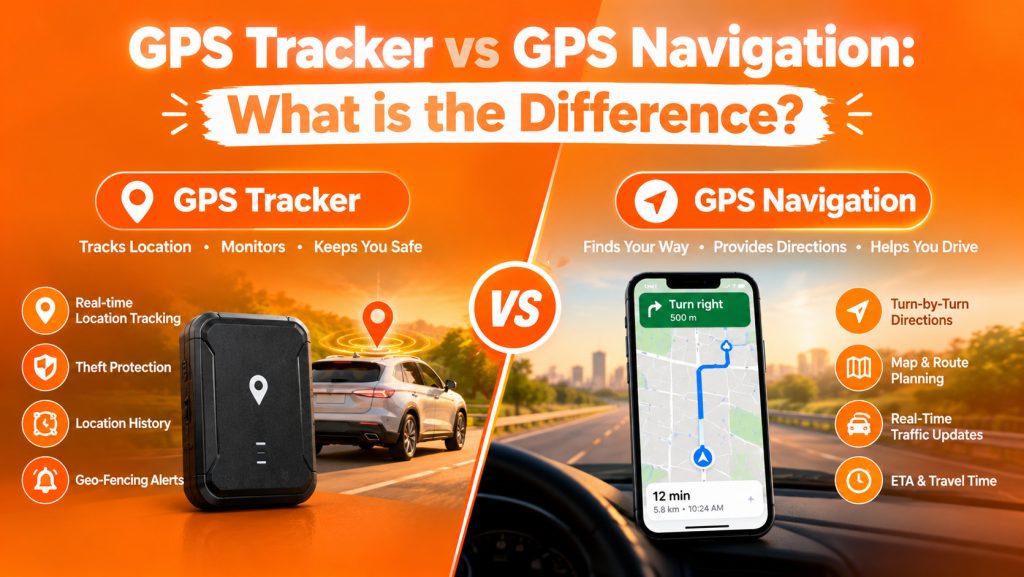
GPS technology has become a part of everyday driving, but two terms that are used interchangeably, but serve very different purposes, are GPS tracker and GPS navigation. Both use location data to tell them where a vehicle is, but that’s about as far as the similarities go. You’re building a GPS navigation system to get you somewhere. GPS trackers are designed to help you know where a vehicle is and where it has been. It is important to understand this difference when considering technology for a personal car, business vehicle, delivery fleet or company owned vehicles. Some systems do not necessarily have to be installed on every car knowing exactly what each system does can help you make the decision about whether it is a good fit for you or not and not wasting money on features that you may not use.
What is a GPS Tracker?
A GPS tracker is a device that detects the position of a vehicle, usually sending this information to a monitoring system, mobile app or online platform. Some trackers will display the vehicle’s current location in real time, or allow you to review past trips, see the speed, mark a location for future tracking, or see other information about the vehicle. A vehicle GPS tracker is especially useful if the initial purpose is monitoring, not navigation. For example, a business owner may want to know whether a delivery vehicle is on its assigned route. A fleet manager might want to locate several vehicles simultaneously. A private owner of a vehicle might want to be able to know when a car leaves a certain place, and see the location. GPS tracking systems today can be part of a larger telematics solution, in which location data is combined with other vehicle or driver data.
What is GPS Navigation?
The GPS navigations are designed to assist the drivers to travel from one place to another place. A navigation system adds positioning data to digital maps , roads , destinations and routing information to give directions. You can enter a destination into a navigation app or an in-car GPS navigation system and it can map out a route and give you step-by-step directions. Depending on the system, it may also provide information such as estimated travel time, traffic conditions, road closures, alternative routes or points of interest. GPS navigation system is driver oriented. It helps the driver get to where they want to go, and get there efficiently. A GPS tracking system is vehicle focused. It provides location information viewable by the owner, manager or authorized user. Say you run a delivery company with 20 cars. The driver can use GPS navigation to help them find the best way to each customer’s address. At the same time, the company could also use GPS tracking to monitor the location of those 20 vehicles, review their travel history and ensure that vehicles are following expected routes. So the two technologies can work together rather than against each other.
How does a GPS Tracker work?
A GPS tracker listens to satellites to determine its location. GPS itself provides location information, and the tracking device uses a communication technology such as a cellular connection to send that information to a tracking platform or application. The GPS satellites do not follow your vehicle closely. They send signals that a receiver uses to figure out its position. Vehicle tracking devices can tell where the vehicle is. That information can be sent to a connected system. Depending on the product, users may then be able to see the vehicle’s current or recent location on a digital map. That makes it possible to track vehicles in real time. The exact update frequency differs between tracking systems. Some update their location very often, while others use longer intervals to balance tracking needs, network availability and battery or power consumption.
How does GPS Navigation Work?
GPS navigation also uses location data, but it also does something else. The navigation device or app uses your current location and some digital mapping and routing information to figure out where you are and how to get to where you’re going. Imagine you’re driving in Dhaka and you want to cross town. Your navigation system uses its map and traffic data to figure out approximately where you are, where you want to go and to calculate a suitable route. Then the system gives you voice or visual instructions as you drive. GPS navigation is mainly about the guidance of routes, planning of destinations and assistance in driving.
Features of A GPS Tracker
Features offered will vary based on the specific tracking product, but vehicle GPS trackers tend to focus on monitoring and reporting. It provides capabilities such as real-time location tracking, historical route data, geofencing, speed alerts, trip history, and vehicle entry and exit from a pre-defined area alert. These skills can come in very handy for companies. A fleet manager can have a clearer view of vehicle movements without calling each driver for a location update. Some advanced systems can also combine GPS data with vehicle information and driver behavior. This can turn a simple location tracker into a larger fleet management or telematics solution.
GPS Navigation Features
The goal of GPS navigation systems is to help drivers make decisions while they are driving. Typical features include turn-by-turn navigation, route calculation, destination search, digital maps, estimated time of arrival and alternative route suggestions. Depending on the platform, live traffic and road information may also be included in navigation. Thus navigation is most useful where the immediate problem is finding how to get to a destination in the best way. A business owner doesn’t always have a full history of where a vehicle has been from a navigation system. This is where dedicated GPS Tracking comes in more handy.
GPS Tracker or Navigational GPS – Which One Do You Need?
What is best depends on what you are trying to achieve. If you mostly want to get directions, discover new places, avoid traffic, or plan a route, you probably want GPS navigation. A GPS tracker is better if you want to track a vehicle’s location or travel history, get alerts on movement or control multiple vehicles. For Companies It is not always an either-or between the two. The company can use GPS tracking for navigation for the drivers, management and operational visibility. This is especially the case for logistics companies, delivery businesses, rental companies, field-service organizations and companies with multiple company vehicles.
So Is A GPS Tracker a Navigation System As Well?
A GPS tracker and a navigation system are usually two different things, but some of the latest car technology can integrate various functions. The tracking device may be able to show the vehicle’s location on a map, but it may not have turn-by-turn directions. Likewise, a navigation app can tell you where you are and how to get to where you want to go but it is not a fleet tracking app. This makes a big difference when you are comparing products. Just because a vehicle shows up on a map doesn’t mean the device has full navigation capabilities. If you buy a vehicle tracking system, don’t assume that every GPS-enabled device does the same job, check the specs.
GPS Navigation vs GPS Tracking for Business
GPS tracking can give companies more than just the location of a vehicle. If you have a fleet of vehicles in a company, data tracking can help you learn about vehicle utilization, track routes, improve dispatching, and investigate unexpected stops or movements. It can also help communication since managers can access location information without needing to contact drivers constantly. Navigation, in contrast, is more useful to the driver. It assists in route planning and reaching customer locations. That’s why many businesses benefit from having both technologies. Tracking supports the operation behind the journey, navigation supports the journey. IFAD Autos is a useful reference point for companies looking for a vehicle tracking solution, when researching GPS tracking technology and vehicle monitoring solutions.
Is GPS Tracker An Internet Necessity?
The GPS receiver can determine its position using only the signals from the satellites, without the need for the Internet. But a lot of modern vehicle tracking systems use a cellular or other communications link to send the location of the vehicle to a remote server or mobile app. This is a key point of differentiation. You can probably find your way with a navigation device without an active internet connection, but you might need connectivity for map availability and features like live traffic. But if you want to see the location of the vehicle in real-time remotely, a vehicle tracker will usually require some kind of communication link. The exact requirements depend on the type of tracker and service.
Is GPS Tracking the Same as Vehicle Navigation?
No. GPS tracking and vehicle navigation use similar positioning technology, but they solve different problems. Navigation is the process of moving from A to B. The owner or authorized user can use GPS tracking to see where the vehicle is and how it is moving. Navigation is like a driving assistant, and tracking is like a vehicle monitoring system. This simple distinction helps to understand why companies use both often.
Frequently Asked Questions
GPS Tracking vs. GPS Navigation: What’s the Difference?
GPS tracker is used to track the location and movement of a vehicle, while GPS navigation is used to give directions and route guidance to get a driver to a destination.
Can I use a GPS tracker to get directions?
Not really. Most dedicated GPS vehicle trackers are designed for location monitoring, not turn-by-turn navigation. Some integrated automotive systems may have both of these.
Can GPS Navigation Follow A Car?
Navigation systems can tell you where your car is right now, but that doesn’t mean someone can remotely track your car’s location or see where it’s been. For that, dedicated GPS tracking systems are built.
GPS Tracking vs Navigation: Which is Better for Business?
Many companies utilize them for a variety of purposes. The navigation will guide the drivers to their destinations and the managers will be able to track the vehicles, routes and movements with GPS tracking. Both could be a good thing for companies with more than one vehicle.
Will a GPS tracker work without the internet?
The GPS receiver doesn’t need the internet to figure out its position from the satellite signals. But generally, remote tracking requires a communication link to transmit location information from the vehicle to the monitoring platform.
Can GPS tracking be used for one personal car?
Depending on the system the vehicle GPS tracker can provide location visibility, travel history, movement alerts and other monitoring features. Whether it is worth it or not is up to the owner’s needs.
Final Thoughts
GPS trackers and GPS navigation systems use the same basic location technology, but they are used for different purposes. GPS navigation helps you find your way. GPS tracking helps you know where a vehicle is. A navigation system should be enough if you only need to know the way on the road. However if you are looking to track a vehicle remotely, go through its moves or manage a fleet then a dedicated GPS tracking system is the more relevant solution. It can be particularly powerful for businesses. It aids drivers in navigation and provides greater visibility of vehicle operation for owners and fleet managers. When selecting a system, focus less on the word “GPS,” and more on what you want the technology to do. Look at tracking features, connectivity, reporting, alerts, monitoring options and support to find a solution that offers practical value rather than just another device in your vehicle.